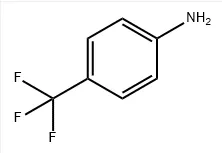
4-Aminobenzotrifluoride CAS No.:455-14-1
This product serves as pharmaceutical secondary standards for quality control purposes. It offers pharmaceutical laboratories and manufacturers a convenient, cost-effective alternative to preparing in-house working standards.
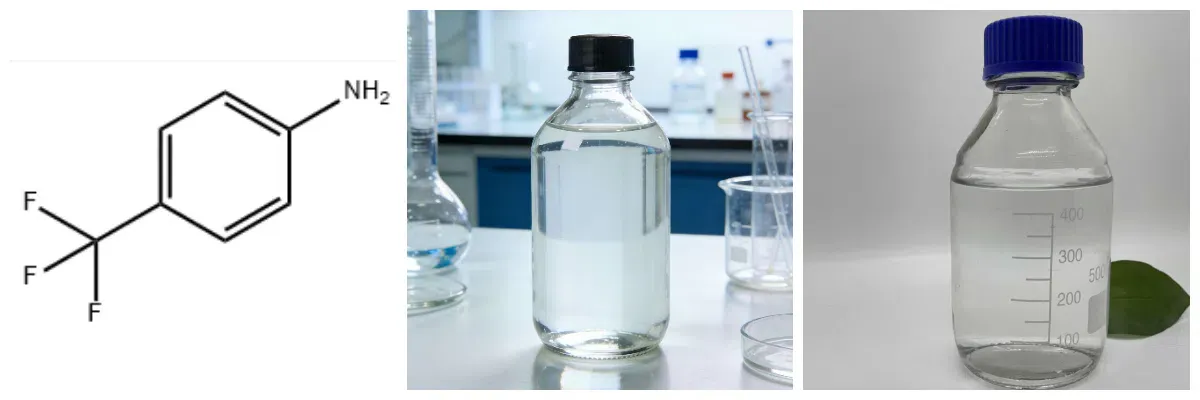
4-Aminobenzotrifluoride Chemical Properties |
Melting point | 3-8 °C |
Boiling point | 83 °C12 mm Hg(lit.) |
density | 1.283 g/mL at 25 °C(lit.) |
refractive index | n |
Fp | 188 °F |
storage temp. | Keep in dark place,Inert atmosphere,2-8°C |
solubility | DMSO (Slightly), Methanol (Slightly) |
form | Liquid |
pka | 2.45(at 25℃) |
color | Clear colorless to yellow |
Specific Gravity | 1.283 |
Water Solubility | <0.1 g/100 mL |
Sensitive | Air Sensitive |
BRN | 1564853 |
InChI | 1S/C7H6F3N/c8-7(9,10)5-1-3-6(11)4-2-5/h1-4H,11H2 |
InChIKey | ODGIMMLDVSWADK-UHFFFAOYSA-N |
SMILES | Nc1ccc(cc1)C(F)(F)F |
LogP | 1.95 at 20℃ |
CAS DataBase Reference | 455-14-1(CAS DataBase Reference) |
NIST Chemistry Reference | Benzenamine, 4-(trifluoromethyl)-(455-14-1) |
EPA Substance Registry System | 4-(Trifluoromethyl)aniline (455-14-1) |
Safety Information |
Hazard Codes | T,N,Xi,Xn |
Risk Statements | 25-36-50/53-36/37/38-33-20/21/22 |
Safety Statements | 26-45-60-61-36/37/39-36 |
RIDADR | UN 2810 6.1/PG 3 |
WGK Germany | 3 |
RTECS | XU9260000 |
Hazard Note | Toxic/Irritant |
TSCA | TSCA listed |
HazardClass | 6.1 |
PackingGroup | III |
HS Code | 29214300 |
Storage Class | 6.1C - Combustible acute toxic Cat.3 |
Hazard Classifications | Acute Tox. 3 Oral |
Aminobenzotrifluoride CAS#455‑14‑1
Product Overview
Product Name: 4‑Aminobenzotrifluoride CAS No.:455‑14‑1 Synonyms: 4‑(Trifluoromethyl)aniline; α,α,α‑Trifluoro‑p‑toluidine; TIMTEC‑BB SBB003956 Molecular Formula: C₇H₆F₃N Molecular Weight: 161.12 g/mol
This fluorine‑containing aromatic compound serves as an important organic synthetic building block. It can also be used as pharmaceutical secondary standards for quality control, offering pharmaceutical laboratories and manufacturers a convenient and cost‑effective alternative to prepare in‑house working standards. The unique trifluoromethyl group endows the molecule with outstanding chemical stability and adjustable biological activity, making it widely demanded in pharmaceutical, agrochemical, dyestuff and advanced new material sectors.
Physical & Chemical Properties
Basic Parameters
It appears as clear, colorless to pale‑yellow liquid. Its melting point ranges from 3‑8 °C, boiling point is 83 °C at 12 mmHg. The density is 1.283 g/mL at 25 °C, with a refractive index n₂₀/D 1.483 and closed‑cup flash point of 87 °C. It is slightly soluble in water, while miscible in methanol, ethanol, ether and other aromatic organic solvents. The product is sensitive to air, and must be kept far away from strong oxidants and strong acids.
Stability & Hazard Characteristics
It remains stable under recommended storage conditions. When heated and decomposed, it will release harmful toxic fumes including nitrogen oxides, carbon monoxide and hydrogen fluoride. This substance falls into toxic hazardous goods. Direct skin contact, eye splash and vapor inhalation should be strictly avoided during handling.
Product Application
Original content: 4‑(Trifluoromethyl)aniline was used in the synthesis of 4‑(trialkylmethyl)anilines. It was also used as a synthetic building block.
Pharmaceutical Industry
It acts as pharmaceutical secondary standards for laboratory quality calibration, helping pharmaceutical institutions cut costs and simplify workflows instead of preparing internal working standards on their own. Besides calibration usage, it is a key intermediate for multiple active pharmaceutical ingredients. It is commonly applied in the synthesis of drugs for autoimmune disease treatment. The introduced trifluoromethyl structure improves the metabolic stability and target selectivity of drug molecules. It is also widely adopted in custom synthesis and pilot R&D projects of new medicines for pharmaceutical research labs.
Agrochemical Field
It is a core building block for high‑efficiency fluorinated agrochemical products. It can be derived into intermediates for insecticides, insect growth regulators and selective herbicides. The trifluoromethyl functional group greatly boosts biological activity, helping final pesticide products achieve better crop protection performance.
Dyestuff & Advanced Material Synthesis
It is an essential raw material for fluorine‑containing azo dyes, which can enhance the weather resistance and color fastness of dye products. It can also be used as a precursor monomer for high‑performance fluorinated polymers such as polyamide‑imide, bringing excellent anti‑ultraviolet and corrosion‑resistant properties to polymer materials. In organic synthesis laboratories, it can undergo diazotization, halogenation and coupling reactions to produce a series of fine chemical derivatives.
Manufacturing Process Highlights
The mainstream industrial production route adopts benzotrifluoride as starting material, through nitration reaction and subsequent catalytic hydrogenation reduction to get crude 4‑Aminobenzotrifluoride. The crude product will go through neutralization, rectification and deep purification to reach commercial purity standard. There is an alternative process via high‑pressure ammonolysis of 4‑chlorobenzotrifluoride. The whole production line is controlled strictly to reduce impurity content, to satisfy strict purity requirements for pharmaceutical grade customers.
Packaging & Transportation
Packaging Options
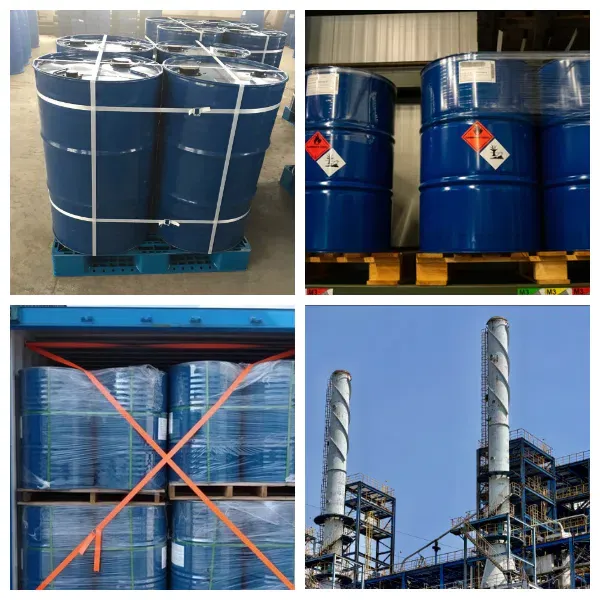
For small trial samples for laboratory testing, we supply 250mL, 1L or 5L amber glass bottles fitted with PTFE lined caps. For bulk commercial orders, standard packing is 200kg HDPE drums. IBC tote tanks are available for large volume FCL shipment. Our standard MOQ is 1 FCL for formal bulk batch.
Transport Regulations
This product is classified as UN 2948, Hazard Class 6.1 toxic substance, Packing Group II. All shipments need to comply with IMDG and IATA dangerous goods rules. It cannot be loaded together with strong oxidants, strong acid materials or food related goods. We can provide complete SDS, COA and other shipping documents to support smooth customs clearance.
Storage Requirements
Please store the product in a cool, dry and well‑ventilated warehouse. It is suggested to seal it under inert gas protection and keep storage temperature at 2‑8°C. Containers must be tightly sealed to prevent contact with air. Keep separately from oxidants, heat sources and open flames. The shelf life is 12 months under original sealed packaging.
Delivery Time
If the goods are in stock, we can arrange shipment within 2‑3 working days after order confirmation. For customized newly produced batches, the production cycle is about 7‑10 working days.
Quality Assurance & After‑sales Service
Quality Documents Supplied
Each shipment batch comes with official Certificate of Analysis (COA), MSDS/SDS and HPLC‑GC test report. We accept customized testing item requirements for pharmaceutical laboratory clients.
After‑sales Support
We provide professional technical consultation about product application, safe storage and operation guidance all the time. Our team can assist you to prepare all kinds of export declaration documents. We promise to respond to your quality feedback within 24 working hours, and follow up to propose proper solutions for any quality related issues.
Typical Customer Scenarios
Our buyers mainly cover pharmaceutical R&D laboratories and API intermediate manufacturers. We also serve agrochemical fine chemical factories for pesticide intermediate production. Universities and scientific research institutes purchase it for organic synthesis experimental projects. Dyestuff factories and fluorine advanced material enterprises source it for polymer monomer preparation.
FAQ
Q1: What purity grades can you provide?
A: Regular industrial grade reaches ≥98.0% by GC test. High purity pharma‑lab grade ≥98.5% GC can be produced on request.
Q2: Is LCL trial order acceptable?
A: Our standard minimum order quantity is one full container load. Nevertheless, small trial samples in glass bottles can be arranged for your evaluation before bulk purchasing.
Q3: What safety precautions should be taken during operation?
A: This product is toxic and sensitive to air. Operators need to wear chemical goggles, resistant gloves and organic vapor respirators. All operations should be carried out inside a fume hood. Avoid skin contact, eye exposure and vapor inhalation completely.
Q4: Can you supply batches with special calibration report for pharmaceutical secondary standard?
A: Yes. We support customized batches for quality control secondary standards. Extra production lead time will be needed if you require special calibration documents.
Disclaimer: All the data above is for reference only. Please take the SDS and batch COA as the official standard.