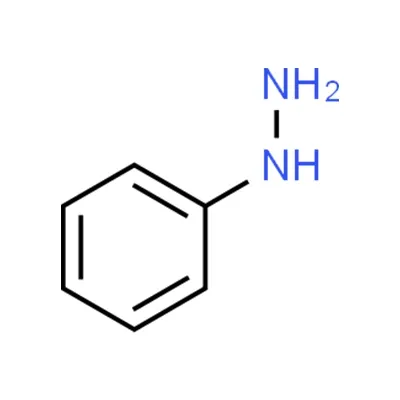
Phenylhydrazine CAS No.:100‑63‑0
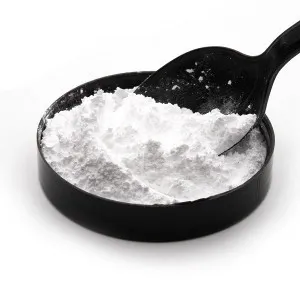
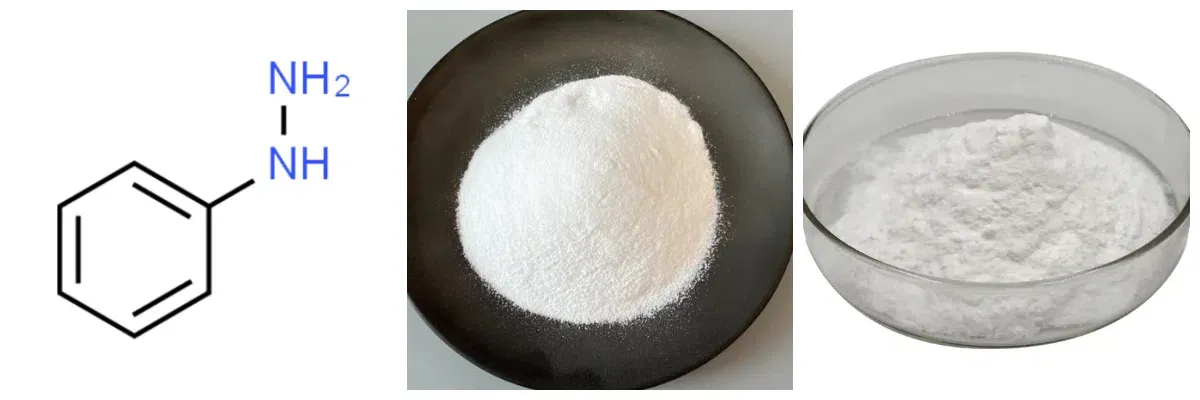
Appearance: Pale yellow crystals; turns into oily liquid. Melting Point: 66 °F Flash Point: 192 °F Autoignition Temperature: 345 °F Solubility: Soluble in alcohol.
Hazard Statement: Toxic if swallowed, inhaled or absorbed through skin.
Phenylhydrazine Chemical Properties |
Melting point | 18-21 °C (lit.) |
Boiling point | 238-241 °C (lit.) |
density | 1.098 g/mL at 25 °C (lit.) |
vapor density | 4.3 (vs air) |
vapor pressure | <0.1 mm Hg ( 20 °C) |
refractive index | n |
Fp | 192 °F |
storage temp. | Store below +30°C. |
solubility | Soluble in dilute acids. |
form | Powder |
pka | 8.79(at 15℃) |
color | White to slightly blue or light beige |
explosive limit | 1.1%(V) |
Water Solubility | 145 g/L (20 ºC) |
Sensitive | Air & Light Sensitive |
Merck | 14,7293 |
BRN | 606080 |
Dielectric constant | 7.2(23℃) |
Exposure limits | TLV-TWA skin 0.1 ppm (0.44 mg/m3) (ACGIH), 5 ppm (22 mg/m3) (OSHA); STEL 10 ppm (44 mg/m3) (OSHA); carcinogenicity: A2-Suspected Human Carcinogen (ACGIH), Carcinogen (NIOSH). . |
Stability: | Stable, but may decompose in sunlight. May be air or light sensitive. Incompatible with strong oxidizing agents, metal oxides. |
InChI | 1S/C6H8N2/c7-8-6-4-2-1-3-5-6/h1-5,8H,7H2 |
InChIKey | HKOOXMFOFWEVGF-UHFFFAOYSA-N |
SMILES | NNc1ccccc1 |
CAS DataBase Reference | 100-63-0(CAS DataBase Reference) |
NIST Chemistry Reference | Hydrazine, phenyl-(100-63-0) |
EPA Substance Registry System | Phenylhydrazine (100-63-0) |
Safety Information |
Hazard Codes | T,N |
Risk Statements | 45-23/24/25-36/38-43-48/23/24/25-50-68 |
Safety Statements | 53-45-61 |
RIDADR | UN 2572 6.1/PG 2 |
OEL | Ceiling: 0.14 ppm (0.6 mg/m3) [2-hr] [skin] |
WGK Germany | 3 |
RTECS | MV8925000 |
F | 8-10-23 |
Autoignition Temperature | 345 °F |
TSCA | TSCA listed |
HS Code | 2928 00 90 |
HazardClass | 6.1 |
PackingGroup | II |
Storage Class | 6.1A - Combustible, acute toxic Cat. 1 and 2 |
Hazard Classifications | Acute Tox. 3 Dermal Acute Tox. 3 Inhalation Acute Tox. 3 Oral |
Hazardous Substances Data | 100-63-0(Hazardous Substances Data) |
Toxicity | LD50 orally in Rabbit: 188 mg/kg |
IDLA | 15 ppm |
Phenylhydrazine CAS#100‑63‑0
Product Overview
Product Name: Phenylhydrazine CAS No.:100‑63‑0 Synonyms: 1‑Hydrazinobenzene, Phenyl hydrazide, Phenylhydrazine, 95% Molecular Formula: C₆H₈N₂ Molecular Weight: 108.14 g/mol
As the first‑generation synthetic hydrazine derivative, Phenylhydrazine is a versatile fine‑chemical building block widely used in dyestuff, pharmaceutical, agrochemical and analytical chemistry industries. This product appears as pale‑yellow crystals and will gradually turn into oily liquid during storage. It is combustible and highly toxic through multiple exposure routes. Strict operation, storage and transportation specifications are required throughout the supply chain. Our standard MOQ for bulk commercial shipment is 1 FCL (Full Container Load).
Physical & Chemical Properties
Basic Physical Parameters
It is pale yellow crystals and will become oily liquid under normal storage conditions. Its melting point is 66 °F, flash point is 192 °F, and autoignition temperature is 345 °F. It is soluble in alcohol. The product is sensitive to air and light, and its quality will degrade gradually once exposed to the open atmosphere.
Toxicity & Health Hazard Profile
Phenylhydrazine is toxic by ingestion, inhalation and skin absorption. Inhalation may cause hemolysis, leading to anemia and headache; severe exposure can even result in jaundice. It is strongly irritating to eyes and may cause corneal disorders. The oral LD50 of rats is 188 mg/kg. The maximum allowable concentration in the workplace is 0.44 mg/m³. Operators must avoid skin contact, eye contact and inhalation of its vapor during operation.
Chemical Stability
It remains stable under properly sealed storage conditions. It may react violently when mixed with strong oxidants. It will decompose under high temperature and release toxic nitrogen‑containing fumes.
Product Application
Phenylhydrazine is the first synthetic hydrazine derivative, commonly used as an intermediate for organic dyes, pharmaceuticals and pesticides.
Dyestuff Industry
It is an essential intermediate for disazo dyes, and serves as raw material for synthesizing 1‑phenyl‑3‑methyl‑5‑pyrazolone and other azo dye derivatives. It participates in diazo coupling reactions to prepare a variety of colorant molecules.
Pharmaceutical Industry
It is a key synthetic intermediate for antipyretic, analgesic and anti‑inflammatory drugs, including antipyrine and aminopyrine. It can also be used for the preparation of photosensitive dyes applied in the photographic chemical field.
Agrochemical Sector
It is an important raw material for the production of organophosphorus pesticides. It can be used to construct heterocyclic skeletons to synthesize pyrazoline, triazole and other pesticide intermediates.
Organic Synthesis & Chemical Analysis
It is widely used in laboratory organic synthesis for the preparation of heterocyclic compounds such as pyrazoline, triazole and indole. Besides, it acts as a classic carbonyl identification reagent for qualitative identification of aldehydes, ketones and carbohydrates.
Manufacturing Process Highlights
The mainstream industrial production route uses aniline as the starting raw material. Aniline reacts with sodium nitrite in a hydrochloric acid environment to generate diazonium salt. The diazonium salt is then reduced by sulfur dioxide and sulfurous acid to obtain phenylhydrazine sodium sulfonate. After salting out with hydrochloric acid, phenylhydrazine hydrochloride is formed. Phenylhydrazine is finally obtained through neutralization and deacidification. Temperature and pH are strictly controlled in the diazotization and reduction steps to suppress side reactions and reduce impurities.
Packaging & Transportation
Packaging Solutions
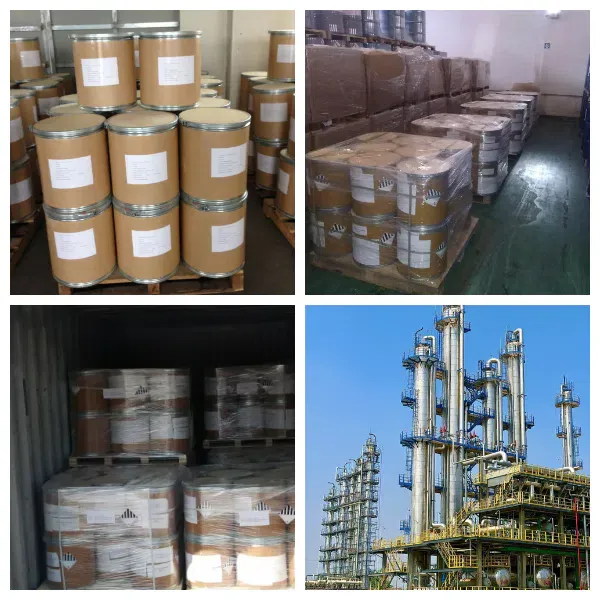
Amber sealed glass containers are available for laboratory trial samples to block air and light. Specially certified UN metal drums are adopted for large‑scale bulk orders. The standard bulk MOQ is one full container load. All packages are tightly sealed, and inert gas filling is optional for long‑distance ocean transportation.
Transport Regulation
UN Number: UN 2572, Hazard Class 6.1 (toxic substance), Packing Group II. All shipments shall comply with IMDG, ADR and IATA dangerous goods transport rules. It cannot be loaded together with strong oxidants, strong acids or food‑related goods. We can provide complete SDS, COA and hazard declaration documents to support customs clearance.
Storage Requirements
Store in a cool, shaded and well‑ventilated warehouse. Keep containers tightly sealed to isolate air and light sources. The recommended storage temperature is 0‑10°C with inert gas protection. Store separately from oxidants, heat sources and open flames. Do not discharge residual liquid directly into the sewer. The shelf life is 12 months under original sealed packaging.
Delivery Time
For in‑stock products, we can arrange shipment within 2‑3 working days after order confirmation. For customized newly produced batches, the whole production and purification cycle takes 7‑10 working days.
Quality Assurance & After‑sales Service
Supplied Quality Documents
Each batch of goods is accompanied with the official Certificate of Analysis (COA), complete SDS safety data sheet and GC test report. We accept customized testing requirements for laboratory and fine chemical customers.
Technical & After‑sales Support
We provide professional technical consultation covering product application guidance, safe operation instructions and storage suggestions. Our export document team can assist you in preparing customs declaration materials. We will respond to your quality feedback within 24 working hours and follow up with targeted solutions.
Typical Customer Scenarios
Fine chemical and dye factories for azo dye intermediate production. Pharmaceutical intermediate manufacturers for antipyretic and analgesic API precursors. Agrochemical enterprises for the synthesis of heterocyclic pesticide intermediates. University laboratories and research institutes for organic synthesis and qualitative analysis experiments.
FAQ
Q1: What purity grades are available for Phenylhydrazine?
A: The regular commercial grade is ≥95%‑96%. Higher purity grade ≥98.0% GC can be produced according to special customer requirements.
Q2: Is LCL small‑batch trial shipment acceptable?
A: Our standard minimum order quantity is one full container load. Small sample packages for laboratory testing can be arranged before formal bulk orders.
Q3: What core safety precautions should operators follow?
A: This product is toxic, air‑sensitive and light‑sensitive. All operations must be carried out in a fume hood. Operators need to wear chemical goggles, chemical resistant gloves and organic vapor respirators. Avoid skin contact, eye splash and vapor inhalation completely.
Q4: What documents can you provide for dangerous goods export customs clearance?
A: We can supply a full set of shipping documents including COA, SDS, UN dangerous goods declaration and other supporting export files as required by local customs.