Product Description of Acrylonitrile CAS#107‑13‑1
Acrylonitrile is a colorless, flammable liquid. Its vapor forms explosive mixtures with open flames. As a high‑volume synthetic unsaturated nitrile with growing market demand, it does not exist in nature.
It serves as a key chemical intermediate. Main applications cover acrylic/modacrylic fibers, high‑impact ABS and SAN plastics, synthetic rubber, pharmaceuticals, antioxidants and dyes. SAN resins are widely applied in auto parts, household goods, packaging and construction. It can produce adiponitrile for nylon manufacturing. Its historical use as pesticide fumigant has been fully discontinued.
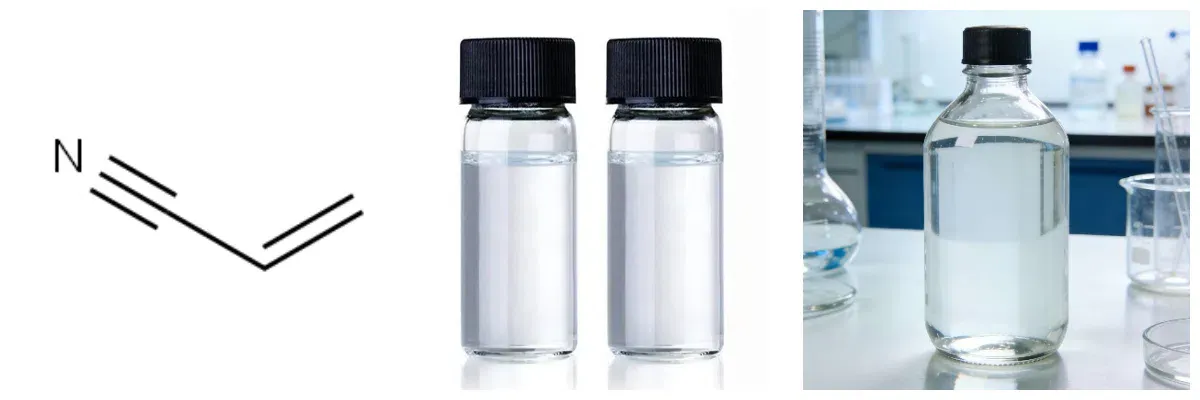
| Acrylonitrile Chemical Properties |
| Melting point | -83 °C (lit.) |
| Boiling point | 77 °C (lit.) |
| density | 0.806 g/mL at 20 °C |
| vapor density | 1.83 (vs air) |
| vapor pressure | 86 mm Hg ( 20 °C) |
| refractive index | n |
| Fp | 32 °F |
| storage temp. | 2-8°C |
| solubility | 73g/l |
| form | Liquid |
| color | Clear |
| Odor | Mild pyridine-like odor at 2 to 22 ppm |
| PH | 6.0-7.5 (50g/l, H2O, 20℃) |
| Odor Threshold | 8.8ppm |
| explosive limit | 2.8-28%(V) |
| Water Solubility | Soluble. 7.45 g/100 mL |
| Sensitive | Light Sensitive |
| Merck | 14,131 |
| BRN | 605310 |
| Henry's Law Constant | 1.30 at 30.00 °C (headspace-GC, Hovorka et al., 2002) |
| Dielectric constant | 33.009999999999998 |
| Exposure limits | NIOSH REL: TWA 1 ppm, 15-min C 1 ppm, IDLH 85 ppm; OSHA PEL: TWA 2 ppm, 15-min C 10 ppm; ACGIH TLV: TWA 2 ppm. |
| Major Application | agriculture environmental |
| InChI | 1S/C3H3N/c1-2-3-4/h2H,1H2 |
| InChIKey | NLHHRLWOUZZQLW-UHFFFAOYSA-N |
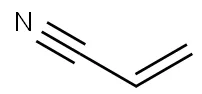
| SMILES | C=CC#N |
| LogP | 0.017 at 21℃ |
| CAS DataBase Reference | 107-13-1(CAS DataBase Reference) |
| IARC | 2B (Vol. 71) 1999 |
| NIST Chemistry Reference | 2-Propenenitrile(107-13-1) |
| EPA Substance Registry System | Acrylonitrile (107-13-1) |
Safety Information |
Hazard Codes | F,T,N,Xn |
Risk Statements | 45-11-23/24/25-37/38-41-43-51/53-39/23/24/25-62-63 |
Safety Statements | 53-9-16-45-61-36/37 |
RIDADR | UN 1093 3/PG 1 |
OEB | D |
OEL | TWA: 1 ppm, Ceiling: 10 ppm [15-minute] [skin] |
WGK Germany | 3 |
RTECS | AT5250000 |
F | 8 |
Autoignition Temperature | 481 °C |
TSCA | TSCA listed |
HazardClass | 3 |
PackingGroup | I |
HS Code | 29261000 |
Hazardous Substances Data | 107-13-1(Hazardous Substances Data) |
Toxicity | LD50 orally in rats: 0.093 g/kg (Smyth, Carpenter) |
IDLA | 60 ppm |
Product Application Of Acrylonitrile CAS#107‑13‑1
Acrylonitrile is applied for acrylic‑fiber, resin and surface‑coating manufacturing. It serves as chemical intermediate for pharmaceuticals and dyes, and functions as polymer modifier. Its old fumigant usage has been phased out. During combustion or pyrolysis of polyacrylonitrile‑based materials, acrylonitrile may release in fire flue gas. Residual acrylonitrile monomer inside ABS/SAN copolymer containers can migrate into food‑simulating solvents; higher temperature accelerates such migration.
Product Basic Information
Basic Identifiers
Product Name: Acrylonitrile
Synonyms: Propenitrile, Vinyl cyanide, Cyanoethylene
CAS: 107‑13‑1
MF: C₃H₃N
MW: 53.06
EINECS: 203‑466‑5
Appearance: Colorless transparent volatile liquid
MOQ: 1 FCL (Full Container Load)
Chemical & Physical Properties
Boiling point: 77.3 °C
Density: 0.806 g/mL (25 °C)
Flash point: −1 °C
Stability: Easy self‑polymerization; stabilizer is mandatory for storage
Hazard: Highly flammable and toxic; vapor‑air mixture is explosive
Production Preparation Method
Industrial acrylonitrile is mainly produced by propylene ammoxidation. After catalytic reaction, crude material goes through quenching, absorption and rectification purification. Polymerization inhibitor is added to prevent polymerization in storage and transit.
Detailed Application Scenarios
Synthetic Fiber & Resin Manufacturing
Key raw material for acrylic fiber, ABS and SAN engineering resins, widely used for household goods, packaging and auto parts.
Surface Coating Industry
Used as monomer raw material for certain surface‑coating formulations.
Fine‑chemical Intermediate
Applied for synthesis of pharmaceutical intermediates and dyes; also acts as polymer‑performance modifier.
Note: Its historical fumigant application has been fully discontinued.
Material‑safety Reference
Polyacrylonitrile‑containing materials may release acrylonitrile under high‑temperature pyrolysis or fire conditions. Residual monomer inside ABS/SAN plastic products can migrate into contact media; temperature rise speeds‑up migration.
Upstream & Downstream Product Information
Upstream Raw Materials
Propylene, ammonia, air, polymerization inhibitor
Downstream Derivatives
Acrylic fiber, ABS resin, SAN resin, surface‑coating monomers, pharmaceutical & dye intermediates, modified‑polymer materials
Safety & Handling Information
Dangerous goods UN1093, Hazard Class 3 + 6.1, Packing Group I.
Keep far away from open flame, heat source and direct sunlight.
Avoid vapor inhalation and skin exposure; wear respirator, acid‑resistant gloves and safety goggles.
Store in cool ventilated flammable‑liquid warehouse; separate from oxidants and strong alkalis; drums must remain sealed.
Packaging & Transportation
Packaging Options
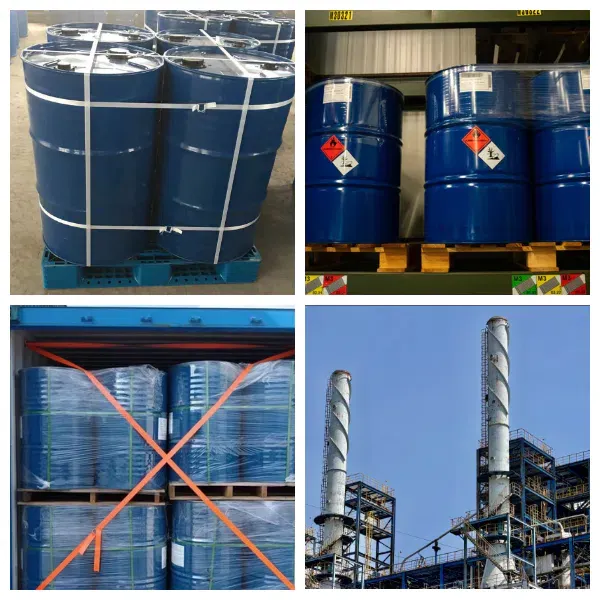
200 L UN‑approved steel drum
ISO tank container for bulk full‑container shipment
Custom packaging available upon special requirements.
Delivery Cycle
Spot inventory: 2‑3 working days
Custom‑made production batch: 7‑10 working days
Full‑container sea shipment: Subject to container‑booking schedule
Transport Requirement
Dangerous‑goods logistics. MSDS and batch‑by‑batch COA documents are provided for every shipment.
After‑sales Service Support
Document service: Freely provide batch COA, MSDS and technical datasheet.
Technical support: Offer application‑process consultation within 24 working hours.
Quality‑complaint handling: Reshipment or exchange for confirmed quality defects. Customers need to submit photos, videos and order information within 7 days on goods receipt. Damages caused by improper storage or misuse are not covered, but technical guidance remains available.
Sample service: Lab test samples can be supplied for pre‑order evaluation.
Customer Application Cases
Case 1: Synthetic‑resin manufacturer
A chemical enterprise purchases stabilized acrylonitrile for ABS resin production. Strict control over residual‑inhibitor content avoids unexpected polymerization during polymerization process.
Case 2: Coating‑material factory
Customers adopt our high‑purity acrylonitrile as modifying monomer for surface‑coating raw‑material synthesis.
FAQ Frequently Asked Questions
Q1: Why must acrylonitrile add stabilizer?
A: It tends to self‑polymerize under heat and light. Stabilizer suppresses polymerization and prevents container blockage.
Q2: Can acrylonitrile be used as fumigant?
A: No, fumigant‑related usage has been completely eliminated.
Q3: What causes acrylonitrile migration from plastic containers?
A: Unreacted residual monomer inside ABS / SAN polymer will migrate into contacting solvents, and higher temperature accelerates this migration.
Q4: Shelf‑life?
A: 6 months under original sealed, cool‑dark storage environment.
Factory & Equipment Show
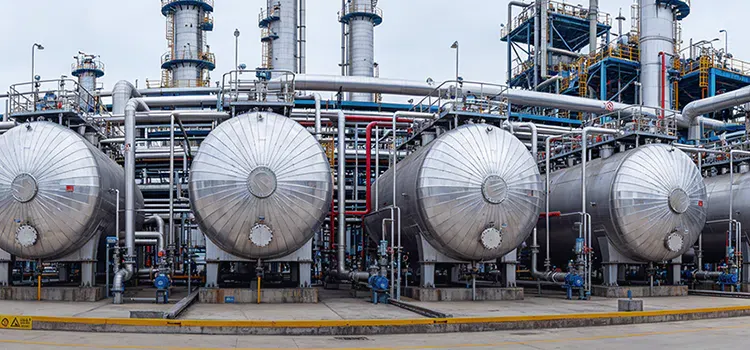
Our workshop is equipped with ammoxidation reaction unit and continuous rectification purification lines. Each batch undergoes testing on purity and stabilizer content before delivery for stable batch‑to‑batch performance.
Fast delivery time
Inventory 2‑3 working days New production 7‑10 working days