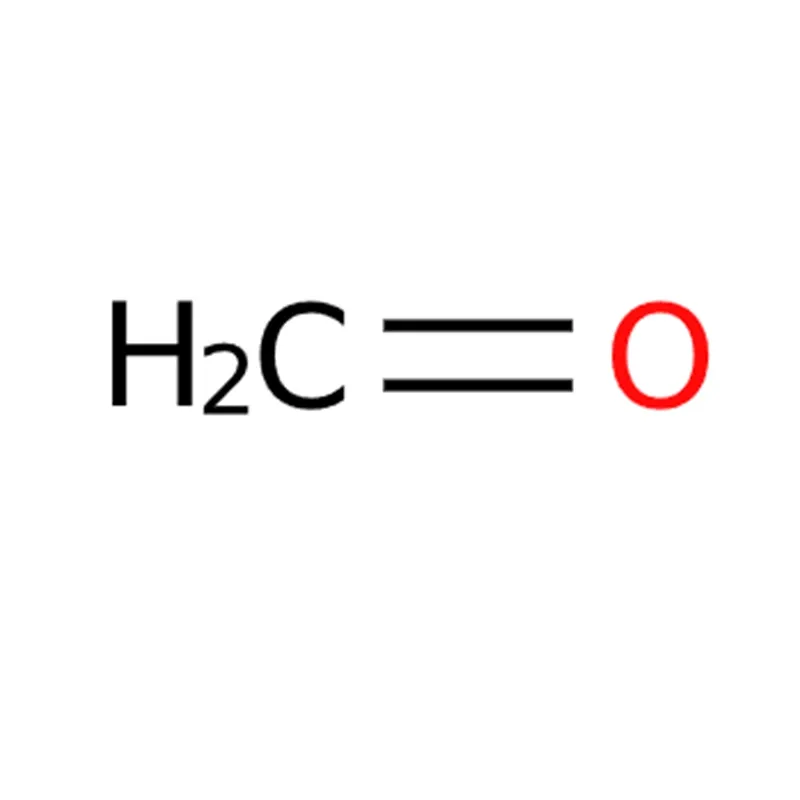
Formaldehyde (CAS: 50-00-0) is the simplest aliphatic aldehyde compound with highly active chemical properties, widely recognized as one of the most fundamental and indispensable raw materials in the modern chemical industry. Featuring a stable molecular structure and strong reactivity, it can easily participate in cross-linking, condensation, and polymerization reactions, making it a critical intermediate for the synthesis of numerous downstream chemical products and polymer materials.
Under normal ambient temperature and pressure, formaldehyde exists as a colorless gas with a typical pungent and irritating odor. It exhibits excellent solubility performance and is completely miscible with water, alcohols, and a wide range of organic solvents, which allows flexible formulation preparation and industrial processing in different manufacturing scenarios. The product is capable of undergoing continuous polymerization to generate polyformaldehyde and other polymer derivatives, providing reliable material foundations for resin production, plastic manufacturing, and chemical synthesis industries.
Naturally and industrially, formaldehyde is commonly generated through fuel combustion, various industrial production processes, and the application of construction and decorative materials. It is also widely present in the production chain of daily consumer goods, supporting massive industrial applications in adhesive manufacturing, textile finishing, wood processing, disinfection materials, and fine chemical production. With its versatile chemical characteristics and mature application technology, formaldehyde remains a core raw material in global industrial chemical supply chains.
Melting point | -15°C |
Boiling point | 97°C(37% solution),-19.5°C(pure) |
density | 1.09 g/mL at 25 °C(lit.) |
vapor density | 1.03 (vs air) |
vapor pressure | 52 mm Hg ( 37 °C) |
refractive index | n20/D 1.377 |
Fp | 133 °F |
storage temp. | room temp |
solubility | water: soluble |
form | Solution |
pka | 13.27(at 25℃) |
color | APHA: ≤10 |
Odor | Pungent odor detectable at 1 ppm |
PH | pH (25℃) : 7.0~7.5 |
Odor Threshold | 0.5ppm |
Water Solubility | soluble |
λmax | λ: 260 nm Amax: 0.01 |
λ: 280 nm Amax: 0.01 | |
Merck | 144235 |
BRN | 1209228 |
Henry's Law Constant | 2.08(x 10-7 atm?m3/mol) at 25 °C (flow-type generation system, spectrophometry, Kanda et al., 2005) |
Dielectric constant | 23.0(Ambient) |
Exposure limits | NIOSH REL: TWA 0.016 ppm, 15-min C 0.1 ppm, IDLH 20 ppm; OSHA PEL: TWA 0.75 ppm, STEL 2 ppm. |
InChIKey | WSFSSNUMVMOOMR-UHFFFAOYSA-N |
LogP | 0.35 |
CAS DataBase Reference | 50-00-0(CAS DataBase Reference) |
IARC | 1 (Vol. Sup 7, 62, 88, 100F) 2012 |
NIST Chemistry Reference | Formaldehyde(50-00-0) |
EPA Substance Registry System | Formaldehyde (50-00-0) |
Hazard Codes | T |
Risk Statements | 23/24/25-34-40-43-39/23/24/25-68-45-68/20/21/22 |
Safety Statements | 36/37-51-45-36/37/39-26-53 |
RIDADR | UN 1198 3/PG 3 |
OEB | E |
OEL | TWA: 0.016 ppm, Ceiling: 0.1 ppm [15-minute] |
WGK Germany | 2 |
RTECS | LP8925000 |
F | 10 |
Autoignition Temperature | 424 °C for formalin containing 15% methanol |
TSCA | Yes |
HazardClass | 3 |
PackingGroup | III |
HS Code | 29121100 |
Hazardous Substances Data | 50-00-0(Hazardous Substances Data) |
LD50 oral (rat) 500 mg/kg | |
LD50 skin (rabbit) 270 mg/kg | |
LC50 inhal (rat) 203 mg/m3 (2 h) | |
PEL (OSHA) 1 ppm (1.5 mg/m3) | |
TLV-TWA (ACGIH) 0.3 ppm (ceiling)(0.37 mg/m3) | |
STEL (OSHA) 2 ppm (2.5 mg/m3) | |
IDLA | 20 ppm |
Formaldehyde boasts powerful reducing performance and remarkable germicidal efficacy. It serves as a reliable human-use disinfectant, while also functioning as an antiseptic and fumigation sterilizer for livestock and animal products.
As a core fundamental organic chemical feedstock, formaldehyde enjoys extensive application across multiple chemical manufacturing sectors. It is widely adopted for producing pharmaceutical intermediates, synthetic fibers, various synthetic resins, plastic preservatives, chemical reducing agents and a full range of derivative chemicals. Its largest consumption lies in synthesizing phenolic resin, urea-formaldehyde resin, melamine resin and polyoxymethylene (POM) resin.
This chemical also acts as a vital raw material to synthesize MDI, pentaerythritol, hexamethylenetetramine and 1,4-butanediol. Beyond synthetic production, formaldehyde has diverse auxiliary uses: it can be deployed for chromatographic testing analysis, industrial sterilization and disinfection, phenolic resin manufacturing, as well as long-term preservation and soaking treatment of biological specimens.
Previous Product: Sodium Amide CAS#7782-92-5
Next Product: Cesium Iodide CAS#7789-17-5